Flight Safety
Operational studies connecting energy, approach stability, go-around decisions, automation and workload.
Explore Flight Safety Member Login
NEXT FLIGHT ACADEMY
Operational knowledge designed to strengthen technical understanding, professional judgment, crew performance and safer flight operations.
BUILT FOR PROFESSIONAL PILOTS
Connect technical understanding with cockpit decisions, monitoring and crew coordination. NFA is an independent aviation knowledge platform—not a ground school, checkride-prep service or replacement for operator training.
Operational studies connecting energy, approach stability, go-around decisions, automation and workload.
Explore Flight SafetyFree access to official weather, NOTAMs, charts, TFRs and NAS resources, with clear source boundaries.
Open U.S. resourcesTechnical studies and professional manuals organized around flight operations, human performance, navigation and aircraft performance.
Browse the library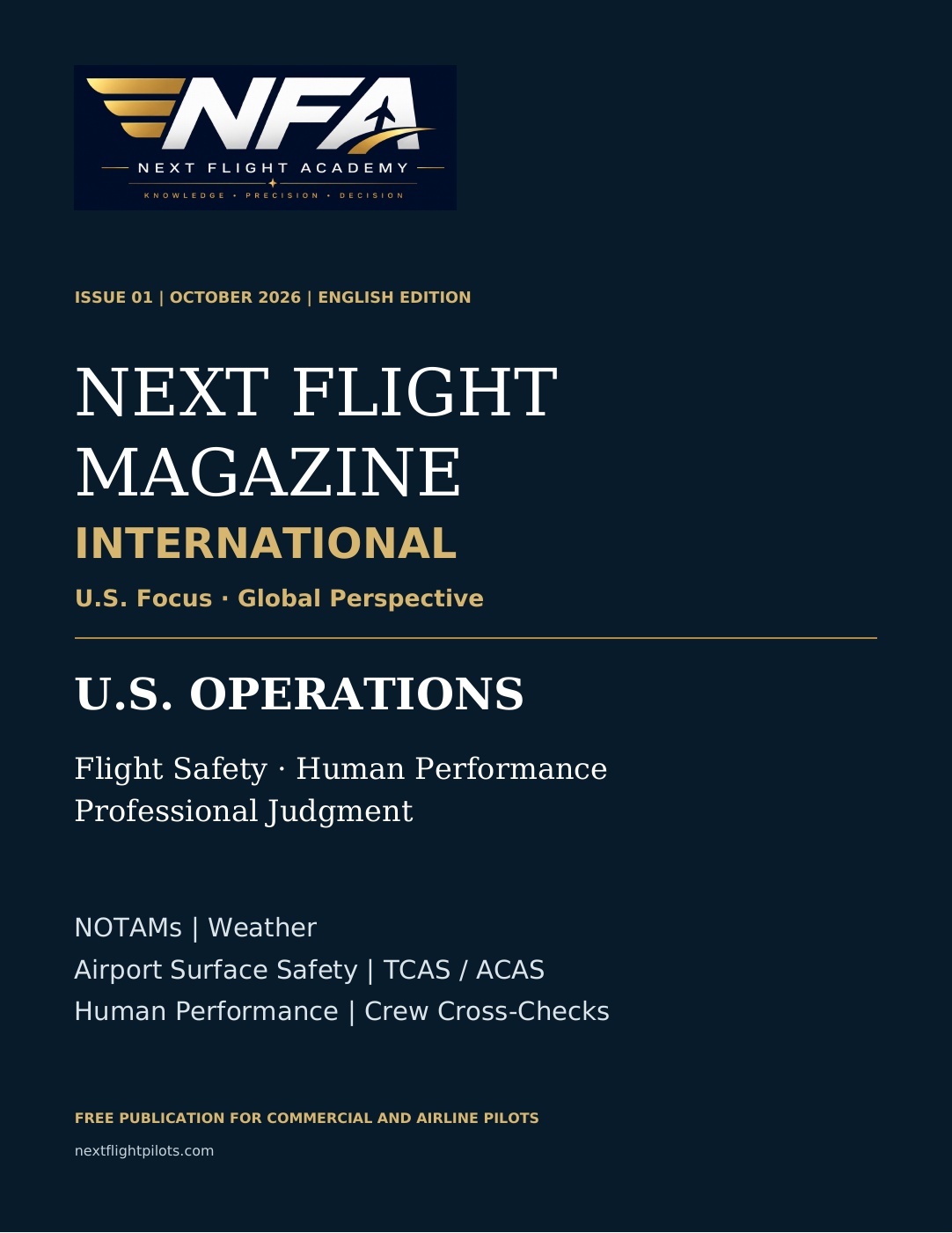
NEXT FLIGHT MAGAZINE INTERNATIONAL · ISSUE 01 · OCTOBER 2026
Evidence-based flight safety, U.S. NOTAMs, weather intelligence, airport surface safety, TCAS and fatigue. Six complete public English articles in one free issue.
English · Free access · 49 pages · PDF and web reading
Read the International issueAVIATION SAFETY INTELLIGENCE
Official-source safety updates selected and summarized for commercial and airline pilots.
Revised SIB 2025-06 warns that severe engine damage or high vibration on CFM LEAP-powered aircraft may activate the Load Reduction Device, release oil into the bleed-air path and produce dense smoke. EASA recommends fleet identification and recurrent-training emphasis under current manufacturer and operator procedures. The SIB is informational and its recommendations are not mandatory.
Read official source ↗CALLBACK issue 560 presents reports involving engines, landing gear and flight-deck systems. NFA takeaway: protect the flight path, divide tasks and use the applicable checklist while diagnosing an abnormal condition. ASRS reports are not verified or validated by NASA.
Read official source ↗The FAA says laser strikes can distract pilots or cause temporary visual impairment even as reported events decline. Crews should use applicable reporting channels and provide location and time information.
Read official source ↗The FAA reported the 100th installation of its Surface Awareness Initiative. The ADS-B-based capability helps controllers monitor aircraft and vehicles in real time, including in low visibility or beyond direct tower sight.
Read official source ↗A 737 encounter with a convective cell near Ajaccio illustrates the consequences of late detection: cabin injuries, hail damage and little time to plan and execute an avoidance manoeuvre.
Read official source ↗An EASA report examines supercooled liquid water, ice crystals and mixed-phase conditions, highlighting persistent limitations in forecasting severity and in-flight ice-crystal exposure.
Read official source ↗NFA summaries support professional awareness. Current aircraft, operator and authority documentation remains controlling for operations.
WHY NFA
Explore how aircraft state, system behavior, threats and human performance influence operational decisions. Use NFA for professional study; use current approved documents for the operation.
Monitoring, communication, workload and decision-making in a professional flight-deck context.
Explore the disciplineMode awareness, energy management and deliberate intervention when intention and aircraft response diverge.
Explore the studySource attribution, educational interpretation, correction reporting and human publication accountability.
Read our standardsNFA PROFESSIONAL
The existing professional library includes advanced studies and manuals for members with active access. Paid subscriptions are not yet open, and no payment is collected on this portal.
Personal learning paths, knowledge-check tracking and the My NFA dashboard are planned for later implementation waves. They are not available yet.
PROFESSIONAL PERSPECTIVE
Professional insight linking study, operational experience and performance reflection.
Read NFA WeeklyNext Flight Magazine International brings English-language reading with a primary focus on American pilots, U.S. operations and flight safety.
Read Magazine InternationalThree numbered reading and discussion guides connect the published U.S. NOTAM, weather and airport surface studies with professional reflection.
Read Professional BriefingsABOUT NFA
Explore NFA in American English or Brazilian Portuguese. Existing articles remain accessible; full-study language availability is identified on the relevant page.