
Study index
- ACAS as an independent safety layer
- Traffic display limitations
- The purpose of a Traffic Advisory
- How an RA changes priorities
- RA priority over conflicting ATC instructions
- Prompt and proportional response
- Changes in RA guidance
- PF and PM duties
- Communication during the encounter
- Common pilot traps
- Preventing unnecessary RAs
- Training and professional takeaways
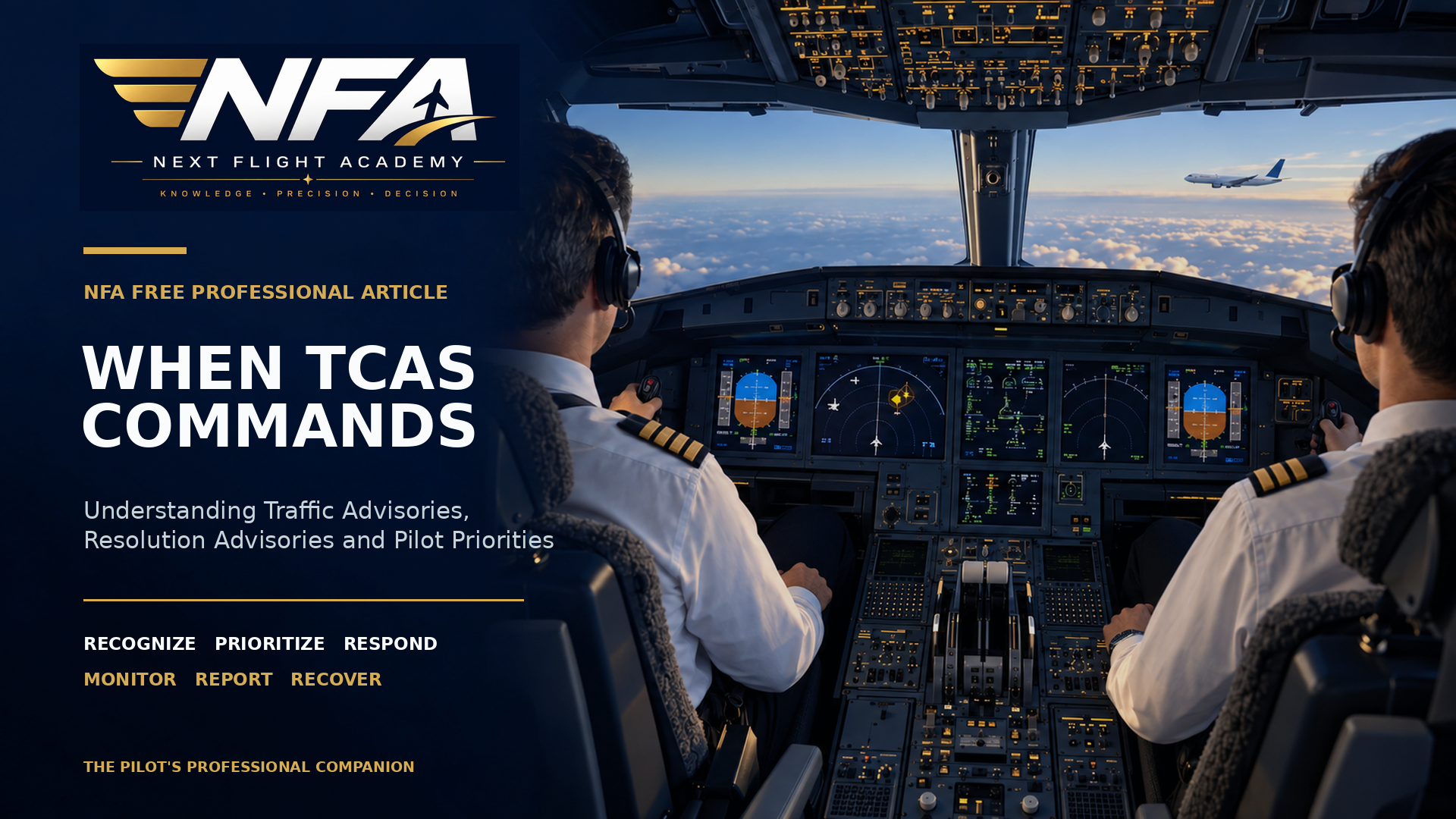
Two aircraft can be operating under air traffic control, flying correctly programmed routes and complying with clearances, yet still move toward an unsafe encounter. Airborne Collision Avoidance System equipment provides an independent final layer of protection when separation has already become uncertain or insufficient.
That protection depends on pilots recognizing the level of alert, applying the correct priority and flying the required response without hesitation, overreaction or improvisation.
This article explains the operational logic of Traffic Advisories and Resolution Advisories without reproducing aircraft-specific procedures. The applicable AFM, FCOM, QRH, SOPs, operator training and regulations remain controlling at all times.
01
ACAS is an independent safety layer
Airborne Collision Avoidance System, or ACAS, is a family of airborne systems designed to reduce the likelihood of a mid-air collision. TCAS is the name widely used for specific implementations of that concept.
ACAS operates independently of the ground-based air traffic control system. It monitors nearby transponder-equipped aircraft and evaluates whether their relative positions are converging toward a hazardous closest point of approach.
ACAS I provides Traffic Advisories. ACAS II systems, including TCAS II and ACAS Xa, provide Traffic Advisories and Resolution Advisories. An RA recommends a vertical maneuver or restriction intended to maintain or increase separation from the threat aircraft.
ACAS does not replace ATC separation, visual lookout or procedural compliance. It adds a final airborne defense.
02
Traffic displays provide a picture, not a clearance
The traffic display improves situational awareness. Depending on the installation and available surveillance data, it may show relative bearing, range, altitude, vertical trend and threat status.
Displayed bearing may lack the precision needed for close visual interpretation. A target may be outside the selected range, without usable altitude reporting or absent because its transponder is not operating.
Pilots must resist using the display as a tactical navigation instrument. A crew should not create its own avoidance turn, climb or descent merely because a traffic symbol appears uncomfortable.
The display supports awareness. The approved alert and procedure determine the response.
03
A Traffic Advisory prepares the crew
A Traffic Advisory identifies an aircraft that may become a collision threat. Its purpose is to alert the crew, assist visual acquisition when practical and prepare both pilots for a possible RA.
A TA changes the crew's attention, not the aircraft's flight path by itself. European and FAA guidance state that pilots should not maneuver solely in response to a TA.
- Acknowledge the alert according to the operator's callout standard.
- Direct attention to the traffic display and outside scan as appropriate.
- Confirm the current flight path, modes and clearance.
- Prepare for a possible Resolution Advisory.
- Avoid abrupt changes that could complicate the encounter.
Visual contact may help, but the traffic seen outside may not be the aircraft generating the alert. Night, cloud and relative motion can make visual interpretation unreliable.
04
A Resolution Advisory changes the priority
A Resolution Advisory indicates that ACAS has calculated a collision threat requiring vertical guidance. The system may require a climb, descent, vertical-speed adjustment, maintenance of a vertical rate or avoidance of a particular vertical maneuver.
Some RAs require an active flight-path change. Others restrict movement that would reduce separation. The exact display, aural annunciation and flight guidance depend on the installed system.
The Pilot Flying should respond immediately by following the RA as indicated, unless doing so would jeopardize aircraft safety.
The response should remain within the guidance shown by the approved display and procedure. Excessive pitch or vertical speed can introduce unnecessary aircraft-state risk.
05
The RA prevails over a conflicting ATC instruction
ATC may issue an instruction without knowing that the aircraft has just received an RA. The controller and the airborne system use different information, logic and time horizons.
If an ATC instruction conflicts with an RA, pilots follow the RA. ICAO guidance also states that pilots must not maneuver in the direction opposite to the RA.
Two ACAS-equipped aircraft can coordinate complementary RAs. One may receive climb guidance while the other receives descent guidance. Ignoring an RA or maneuvering in the opposite sense can destroy the coordinated solution.
During the RA, immediate collision-avoidance guidance has operational priority.
06
Correct response means prompt and proportional
A delayed response allows the encounter to continue closing. An excessive response may create altitude deviation, unnecessary loads, secondary conflict or loss of energy.
The crew should follow the commanded sense and keep the vertical rate within the permitted guidance shown by the installed system. The response should not become more aggressive than necessary.
Startle may produce hesitation while the pilot tries to diagnose the traffic, or abrupt control input driven by urgency. Training must develop a third response: prompt recognition followed by measured control.
The aircraft remains subject to its operating limitations. Aircraft-specific alert priorities must come from approved procedures and training.
07
Follow every change in the RA
An RA can change as the encounter develops. The system may strengthen, weaken, reverse or otherwise modify the original guidance.
The first response does not complete the task. The Pilot Flying must continue monitoring the presentation and comply with any change according to the approved procedure. A reversal is especially time-critical because continuing the original maneuver may rapidly destroy the intended separation.
The Pilot Monitoring supports this process by monitoring the RA, checking the flight path, making required callouts, watching aircraft limits and handling communication when workload permits.
Do not continue interpreting the first command after the system has issued a new one.
08
PF and PM duties must remain clear
An RA compresses control input, flight-mode awareness, vertical-speed monitoring, traffic interpretation and communication into a short period.
The Pilot Flying concentrates on flying the RA accurately. The Pilot Monitoring verifies the response, announces deviations or changing guidance, monitors other threats and communicates with ATC when appropriate.
Useful CRM behaviors include short callouts, explicit task ownership and immediate correction of any response in the wrong sense. Long explanations should wait until the flight path is protected.
Automation handling varies by aircraft. Use only the TCAS response capability approved for the aircraft and operator.
09
Communication supports the maneuver
Flying the RA takes priority over transmitting a report. When workload permits, the crew should notify ATC using the phraseology prescribed by the applicable authority and operator, commonly beginning with “TCAS RA.”
Once the conflict is clear, the crew should promptly return toward the assigned clearance or comply with a subsequent amended clearance, as applicable. ATC should receive the appropriate “clear of conflict” report.
The report explains the departure from the clearance, confirms that the collision-avoidance response ended and states what flight path the crew is now following.
10
The most common pilot traps
- Waiting for visual confirmation. The crew may lose time or identify the wrong aircraft.
- Following ATC against the RA. The controller may not know that the RA exists.
- Maneuvering on a TA. A TA prepares the crew but does not provide maneuver guidance.
- Overcontrolling. Excessive vertical speed can move beyond the required response.
- Treating the first RA as final. Guidance may strengthen or reverse.
- Returning too early. Maintain RA guidance until the system indicates that the conflict has ended.
11
Preventing unnecessary RAs
Collision avoidance begins before an alert. Crews can reduce unnecessary encounters through accurate altitude control, correct transponder and ACAS modes, compliance with restrictions and controlled vertical rates when approaching an assigned level with known adjacent traffic.
European guidance recommends that, when pilots know another aircraft is at or approaching an adjacent level, the last 1,000 feet of climb or descent should normally use a rate below 1,500 feet per minute unless ATC instructs otherwise. Operators should define the applicable procedure.
This technique does not weaken the need to comply with an RA. It reduces the chance that normal level-off geometry will appear as an urgent conflict.
12
Training must produce the correct instinct
Pilots need recurrent exposure to encounters with changing vertical rates, conflicting ATC instructions and revised RAs. Training should verify that crews distinguish TA from RA, avoid maneuvering solely on a TA, respond promptly and proportionally, follow reversed guidance and preserve clear PF and PM roles.
- A traffic display supports awareness but does not provide separation authority.
- A TA prepares the crew. It does not justify a maneuver by itself.
- An RA requires immediate and accurate response unless aircraft safety would be jeopardized.
- Follow the RA even when it conflicts with an ATC instruction.
- Never maneuver in the direction opposite to the RA.
- Monitor for strengthened, weakened or reversed guidance.
- Use only the automation response approved for the aircraft and operator.
- Return to the clearance and notify ATC after the conflict is clear.
Official references
- ICAO. ACAS operating procedures and response to Resolution Advisories.
- Federal Aviation Administration. AC 90-120 — Operational Use of Airborne Collision Avoidance Systems, 20 November 2024.
- European Union Aviation Safety Agency. AMC and GM to the Rules of the Air — guidance associated with SERA.11014.
- European Union Aviation Safety Agency. SIB 2013-11 — ACAS II Manoeuvres Based on Visual Acquisition of Traffic.
This publication supports professional pilot development. It does not replace regulations, ATC procedures, operator manuals or training, or aircraft-specific AFM, FCOM, FCTM, QRH and SOP guidance. The applicable authority, aircraft manufacturer and operator procedures always prevail.