
Study index
The first minutes decide the outcome: a professional flight-deck study of crew protection, aircraft control, source isolation, cabin coordination, lithium-battery events and the decision to land without avoidable delay.
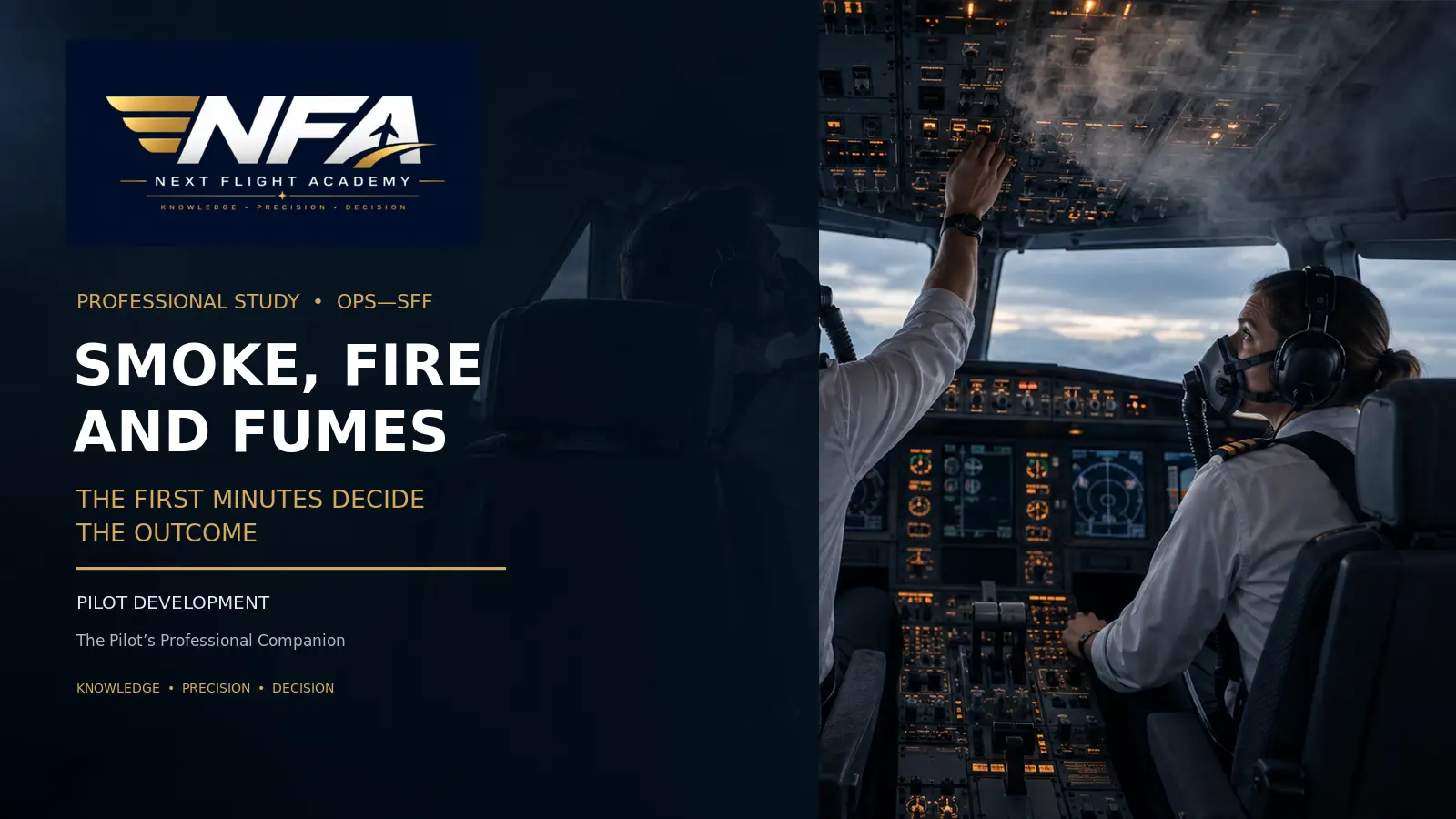
NFA PROFESSIONAL STUDY
Smoke, Fire and FumesOPS—SFF15 ChaptersEnglish2026 Edition01 — STUDY INTRODUCTION
Smoke changes the meaning of time
Smoke or fire is not a routine system malfunction with unlimited troubleshooting time. Heat, toxic products, hidden propagation, electrical degradation and reduced visibility can remove both aircraft capability and crew performance faster than the source can be positively identified.
The professional response protects breathing and vision early, maintains a controlled flight path and begins a landing strategy while approved procedures are being applied.
02 — STUDY INTRODUCTION
Source isolation must not replace aircraft control
Checklists organize action, but every isolation step can remove equipment, information or redundancy. The crew must verify the aircraft response after each approved action and resist an open-ended search for certainty.
The complete edition connects PF/PM discipline, cabin evidence, electrical architecture, hidden-fire behavior and lithium-battery thermal runaway without inventing aircraft-specific procedure.
03 — STUDY INTRODUCTION
The nearest runway is not always the earliest safe landing
The landing decision integrates time to touchdown, weather, runway suitability, terrain, approach complexity, rescue capability and the risk of continued exposure. A technically attractive airport can be operationally wrong if it adds delay or workload.
The study concludes with reduced-visibility approach considerations, evacuation and post-flight hazards, TEM, training scenarios, a professional assessment and consolidated official references.
NFA PROFESSIONAL
Continue with the full professional edition.
This page is a public introduction, not the complete member study.
Open member editionProfessional plan in preparation. Full-study language availability is separate from this introduction.Educational material. Not a replacement for manufacturer manuals, approved operator procedures, MEL/CDL, operational approvals, AIP/NOTAM or regulatory requirements.