
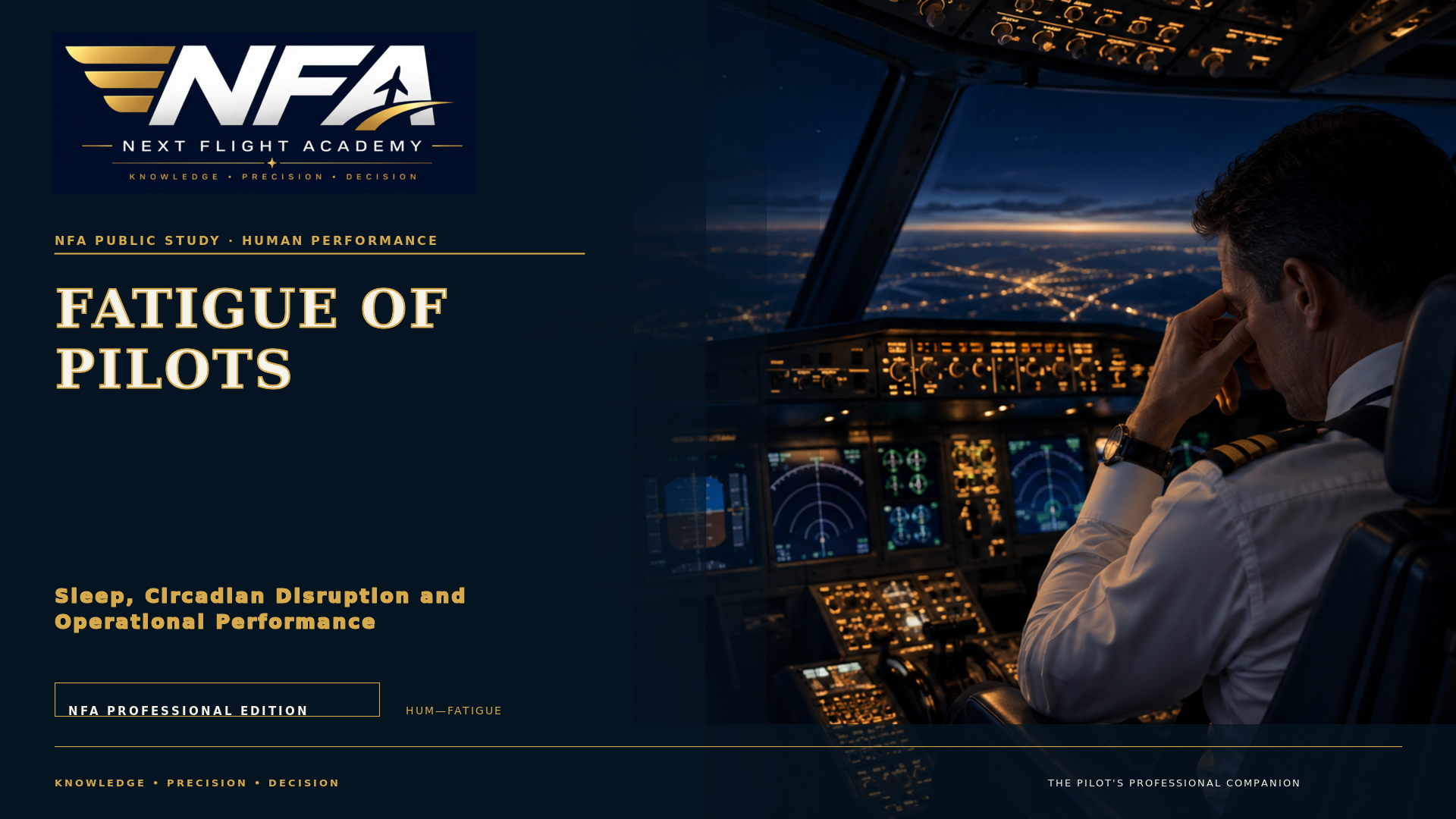
Fatigue rarely announces itself through one dramatic failure. More often, it narrows attention, weakens monitoring and quietly consumes the mental reserve a crew may later need when the operation becomes complex.
01 — UNDERSTANDING THE CONDITION
Being awake is not the same as being operationally alert
In professional aviation, fatigue is more than feeling tired after a demanding day. It is a physiological condition associated with reduced mental or physical performance capability. The pilot may still converse normally, complete familiar actions and appear functional while vigilance, working memory, judgment and the ability to recover from surprise are already less reliable.
Two biological processes are central to understanding why this happens. Sleep pressure grows with time awake and with inadequate recovery, while the circadian system creates predictable changes in alertness across the biological day. Long-haul operations can bring both processes together: extended wakefulness, duty during a circadian low, time-zone displacement, irregular sleep opportunities and an unfamiliar rest environment. The result is not simply discomfort. It is a reduction in the margin available for monitoring, anticipation and sound decision-making.
Fatigue is best understood as a changing operational exposure—not as a personal weakness or a condition that willpower can reliably overcome.
A short period of sleep or in-flight rest may improve alertness, but recovery is not always immediate. Sleep inertia can temporarily impair performance after waking, particularly after deeper sleep or at an unfavorable circadian phase. For this reason, the timing and management of rest must remain within the operator’s approved procedures and fatigue-risk framework.
02 — ON THE FLIGHT DECK
How fatigue changes the quality of performance
The operational concern is not that every fatigued pilot will make an error. It is that performance becomes more variable and less resilient. Attention may become narrower, cross-checks less deliberate and interruptions more disruptive. A crew can continue to perform routine tasks while taking longer to recognize that the situation has changed. Small discrepancies may be noticed but not fully interpreted; an automation mode change may be seen but not connected quickly enough to its flight-path consequence.
Communication can also lose precision. Messages become shorter, assumptions remain unspoken and confirmation may become superficial. Under these conditions, effective CRM is not an abstract interpersonal ideal. Clear task allocation, deliberate verbalization of threats, active monitoring and respectful challenge help the crew preserve a shared operational picture when individual cognitive reserve is reduced.
A fatigued crew may move from anticipating the operation to reacting to it. The earlier that change is recognized, the more time remains to simplify, communicate and protect decision margin.
The exposure can become most consequential during descent, approach, landing, taxi and an unexpected abnormal event. These phases combine high information flow, time pressure and reduced tolerance for delay. Fatigue may make the continuation of an original plan feel easier than the mental work required to reassess it, even when weather, fuel, runway conditions or aircraft status have changed. This is why objective gates, stabilized-approach criteria and company decision frameworks are especially valuable: they reduce reliance on a tired crew’s subjective sense that the situation remains manageable.
03 — MANAGING THE RISK
Compliance provides boundaries; risk management provides understanding
Flight and duty-time limitations establish essential legal and operational boundaries, but remaining within a numerical limit does not guarantee the same level of alertness for every pilot, route or duty. ICAO describes both prescriptive fatigue-management approaches and performance-based Fatigue Risk Management Systems. An FRMS is data-driven and uses scientific knowledge together with operational experience to monitor and manage fatigue-related safety risk. It operates under regulatory approval and within the service provider’s safety-management structure.
Effective fatigue management is therefore shared. Regulators define the applicable framework and oversee it. Operators design schedules, provide rest opportunities, monitor operational data, maintain reporting processes and apply mitigations. Crew members use the rest opportunities provided, assess fitness for duty, follow approved fatigue-reporting procedures and communicate when alertness may be insufficient for the task. None of those responsibilities cancels another.
A mature system looks beyond a single report or individual roster. It searches for patterns: repeated circadian disruption, difficult sequences, short recovery opportunities, disruptive schedule changes, route-specific exposure and the relationship between fatigue reports and other safety data. The aim is learning and continuous improvement—not the promise of eliminating fatigue or achieving zero risk.
Rules establish the operating envelope. A credible fatigue-risk process examines what is actually happening inside that envelope.
04 — PROFESSIONAL JUDGMENT
Protecting the remaining margin
For the pilot, the most useful question is not simply “Am I tired?” It is whether the crew still has the alertness and cognitive reserve required for the operation ahead. That assessment must consider the phase of flight, time awake, recent sleep, circadian timing, workload, weather, airport complexity, aircraft status and the possibility that an abnormal event could suddenly increase demand.
When fatigue risk is present, professional discipline favors early action within the applicable system: acknowledge the condition, share relevant concerns, strengthen monitoring, simplify where permitted, use the operator’s reporting and fitness-for-duty processes, and protect objective decision gates. Caffeine, bright light, activity or conversation may temporarily support alertness in some circumstances, but they do not replace sleep and must not be presented as substitutes for approved rest, scheduling controls or operator procedures.
The deeper lesson is that fatigue management belongs to the same professional chain that guides all NFA education: knowledge supports understanding; understanding supports competence; competence strengthens judgment; and better judgment contributes to safer operations. Recognizing reduced capacity is not a failure of professionalism. Ignoring it can be.
COMPLETE PROFESSIONAL EDITION
Continue through the full human-performance cycle
The protected member edition expands this introduction into 12 structured chapters plus a final professional review, including augmented-crew operations, abnormal-event management, 30 operational rules, three scenarios and a 40-question assessment.
Open the complete protected study →OFFICIAL REFERENCE FRAMEWORK
Continue with the authoritative sources
This article provides educational context. Applicability depends on the current regulations, approvals, manuals and procedures governing each operation.
ICAO — Fatigue Management↗ICAO — Doc 9966 and implementation manuals↗FAA — AC 120-103A: Fatigue Risk Management Systems↗EASA — Fatigue Risk Management↗This NFA article supports professional understanding. It does not provide medical advice and does not supersede ICAO, FAA, EASA, ANAC or other applicable requirements; approved operator fatigue-management processes; flight- and duty-time limitations; company SOPs; or fitness-for-duty and reporting procedures. Always consult the current authoritative material applicable to your operation.